GUIDE · Jili777
Three symbol designs do not mean three equal chances
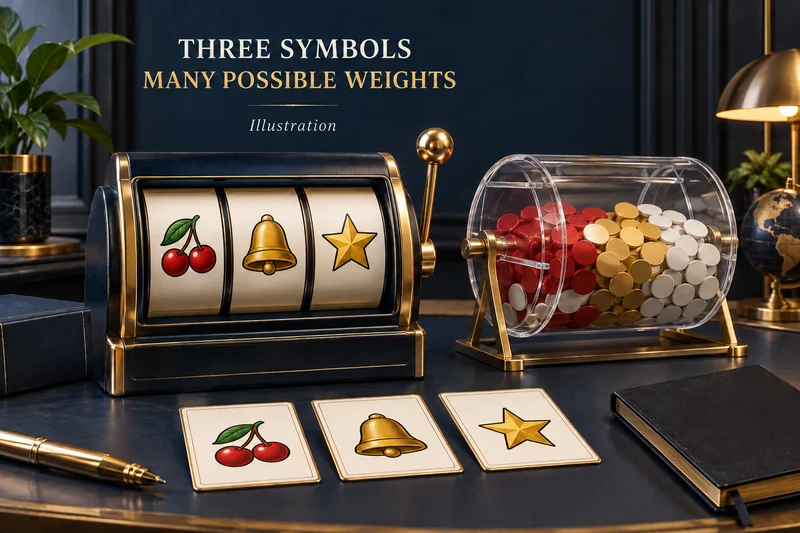
A slot paytable shows a cherry, a bell and a star. Does each have a one-in-three chance of appearing? The picture alone cannot answer that. Three kinds of symbol can represent unequal shares of the underlying outcomes.
It helps to separate the artwork from the mapping that selects it. The model below is intentionally tiny and invented. It is not a reconstruction of a JILI reel, a game test or a published probability table.
Ten equally likely outcomes, three visible designs
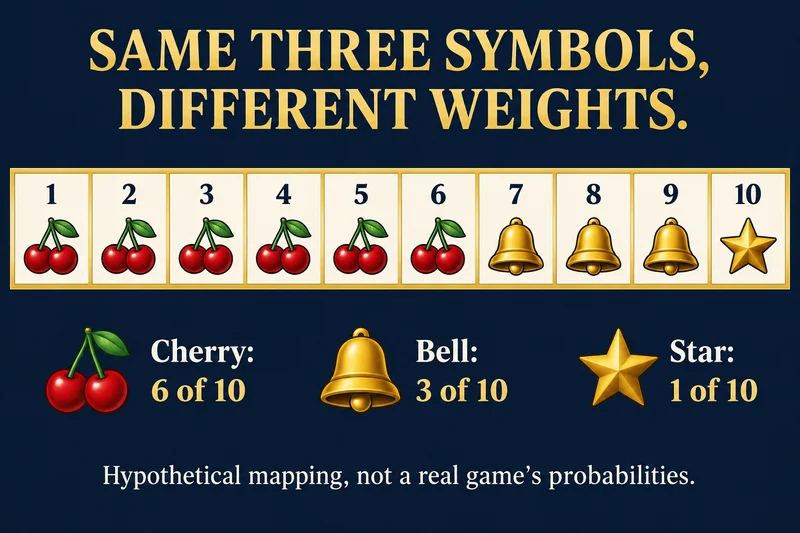
Imagine a random draw of one integer from 1 to 10, with each integer equally likely. A display rule turns the number into a symbol:
| Selected integers | Displayed symbol | Share of the ten outcomes |
|---|---|---|
| 1, 2, 3, 4, 5, 6 | Cherry | 6/10 = 60% |
| 7, 8, 9 | Bell | 3/10 = 30% |
| 10 | Star | 1/10 = 10% |
Every integer has the same chance, yet the three pictures do not. Six integers lead to the cherry, while only one leads to the star. A fair selection from the underlying numbers does not require equal frequencies for the labels mapped onto them.
The same artwork could describe a different model
Keep the same cherry, bell and star images, but assign integers 1–2 to the cherry, 3–5 to the bell and 6–10 to the star. Their shares become 20%, 30% and 50%. Nothing about the three symbol drawings needs to change.
That is why counting the icons in a help screen cannot reveal their weights. Even our first table describes only one selected symbol. It does not specify a full reel layout, substitution rules, winning combinations or awards. Those would need additional definitions before any payout calculation was possible.
Random selection and prize rules are separate layers
The UK Gambling Commission's RTS 7 discusses random outputs and outcomes distributed according to their expected probabilities. It is a UK technical reference, not verification of a particular JILI configuration or Philippine operator.
A displayed symbol frequency would still not be the same as hit frequency. A game may require several positions to form a qualifying combination; some symbols may substitute, trigger features or serve other roles. The paylines, ways and clusters guide explains why position and evaluation rules also matter.
Likewise, an award's size belongs in a paytable, not in an assumption that a rare-looking picture must have a particular probability. Our RTP guide keeps the theoretical return of a configuration distinct from its individual symbols.
What can you responsibly conclude from a screenshot?
You can identify the visible design and retain its label for a rules question. You cannot fill in an unpublished weight just because the paytable contains a certain number of icons. A few observed appearances would also be a sample, not the complete underlying mapping.
For our invented first model, 60%, 30% and 10% are known because we defined every mapping entry. For a real game without that evidence, the corresponding fields remain unknown. That is the useful boundary to carry into the Jili777 guides or the game profiles on Jili777.
AI-assisted source research and original explanation. No gameplay, payments or operator-availability testing was performed. Sources checked 2026-10-08.